


From Filipino Villages to Global Innovation: The Remarkable Journey of Dr. Emmanuel "Noel" Moya
How one engineer's 50-year mission is transforming environmental challenges into opportunities across five continents
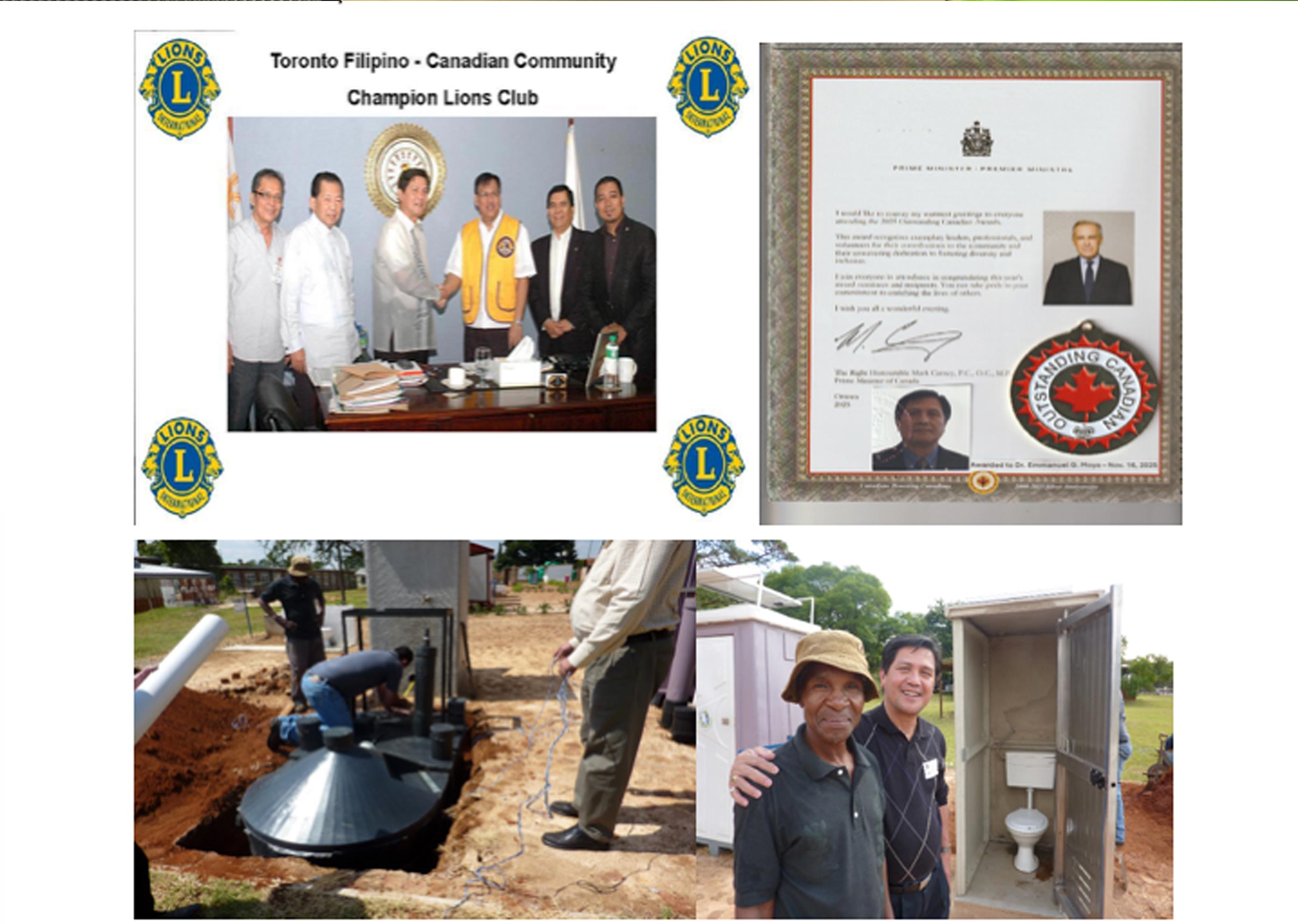
When Typhoon Ondoy devastated the Philippines in 2009, thousands of families lost everything. Among the relief workers coordinating the response was then-DILG Secretary Jesse Robredo, himself a fellow Lions Club member. What he received that day wasn't just another shipment of aid-it was two full containers of assorted medicines, donated by a Filipino-Canadian engineer working quietly from his base in Ontario.
That engineer was Dr. Emmanuel "Noel" Moya, and this story represents just one chapter in an extraordinary five-decade journey of turning environmental problems into innovative solutions.
The Engineer Who Invents Words
At 72, Dr. Moya isn't slowing down-he's accelerating. As President and CEO of both Fluidyne International Corporation and Fluid Exponents Inc., he continues to develop technologies so novel that existing language couldn't describe them. He literally had to invent new words.
"Imagineering." "Leviotation." "Velocentrifugation." "Ferhumiligation."
These aren't just creative linguistic mashups-each term represents a breakthrough concept in environmental engineering that Dr. Moya has brought from imagination to reality. It's fitting that someone who refuses to accept conventional limitations would also refuse to be limited by conventional vocabulary.
Five Decades, Five Continents, One Mission
With a PhD in Electro-Mechanical and Systems Engineering and specialized expertise in Microbiology and Environmental Sciences, Dr. Moya has spent over 50 years practicing across Asia, the United States, Canada, the Caribbean, Latin America, Mexico, the Middle East, and Africa. His resume reads like a United Nations directory of developing countries-because it essentially is.
Through assignments with UNDP/UNEP (United Nations Development Programme/Environment Programme), CESO (Canadian Executive Service Organization, now known as Catalyste+), and Oxfam, Dr. Moya has tackled environmental challenges that most engineers only read about in textbooks:
The Cholera Crisis in Africa (2010): When cholera threatened communities lacking basic sanitation, Dr. Moya launched "Nano-Toilets" across parts of Africa. These ingenious systems combine aerobic and anaerobic digestion to process human and animal waste, capturing biogas for cooking while recycling water for irrigation. The result? A technology that doesn't just prevent disease-it creates resources.
The Legionnaire's Disease Outbreak in New York (2017): While others were still understanding the problem, Dr. Moya was engineering the solution. His integrated water filtration design earned him the Engineering and Invention Award from the Governor of New York for prevention and control of Legionnaire's Disease. The technology was so innovative, it was patented.
The COVID-19 Testing Challenge: When the pandemic struck, Dr. Moya didn't just shelter in place-he developed wastewater test protocols using RNA vs. DNA technology, contributing to early detection systems that helped communities respond faster.
When Big Names Come Calling
Innovation doesn't go unnoticed. Dr. Moya's technologies have been adopted by some of the world's most recognizable companies:
- Halliburton-Schlumberger uses his deep-well drilling technologies for water, gas, and oil extraction
- Frito-Lay implemented his filtration systems for cooking oil treatment
- New York Water Maker replicates his processes to create the perfect water for pizza and bagels (yes, water chemistry matters that much)
- BAC, Marley, and Evapco cooling tower companies are integrating his non-chemical water filtration systems
- Siemens is working with his alternative power generation MagGen technology
- Emterra Environmental, Wheelabrator, Cinergex, and Convectra USA utilize his waste-to-energy innovations
A Trophy Cabinet That Tells Stories
Awards don't define Dr. Moya-but they do chronicle his impact:
- the Outstanding Canadian Award from the Outstanding Canadian Academy for Technology & Invention
- Best 2021 R&D and Best 2022 Mid-size Project (consecutive years) from Professional Engineers Ontario
- 2017 Engineering and Invention Award from the Governor of New York
- 2003 California Environmental Award on Emerging Green Technology for permanent magnet motors and flywheel storage
- Multiple Meritorious Performance Awards from Ingersoll-Rand, Griswold Controls, Claude-Laval, and Emterra Environmental
Each award represents lives improved, resources conserved, or environmental disasters prevented.
The Research Never Stops
While many professionals at 72 are enjoying retirement, Dr. Moya maintains an active R&D portfolio that would challenge engineers half his age:
- MagGen Power Generation using permanent magnets and magnetic axial flywheels
- Beta-Carotene, Ethanol, and Alcohol Extraction from cull carrots, hybrid sweet potatoes, and other root crops
- Satellite Technology for watershed monitoring
- Fractional Hydrogen Injection to improve internal combustion engine performance and reduce pollution
- Mine Tailings Remediation and Precious Metals Recovery, helping Canada's First Nations communities
- Water Treatment Technologies protecting Lake Simcoe and the Holland Marsh farming region
Patents That Protect Innovation
Dr. Moya holds multiple full utility patents covering technologies in:
- Vortex-based centrifugal separators for solid-liquid separation
- Advanced media-based fluid filtration systems
- Accelerated composting processes
- Alternative power generation systems
- Integrated water treatment solutions
These aren't just intellectual property-they're blueprints for a more sustainable world.
Giving Back, Giving Forward
Despite his global reach, Dr. Moya has never forgotten his roots. Beyond the container loads of medicine to typhoon victims, he's:
- Volunteered his expertise to solve mine tailings issues with Canada's First Nations communities
- Helped farmers along Lake Simcoe upgrade water treatment technologies to protect local watersheds
- Served with the Toronto Filipino-Canadian Lions Club on disaster relief efforts
- Worked with the US Army Corps of Engineers on water body challenges
- Collaborated with the Centre for Disease Control on Legionnaire's Disease control and COVID-19 testing protocols
- Consulted with the US and Canadian Navy and Coast Guard on hydrogen injection for marine engines
The Professor Who Never Stopped Being a Student
At an age when most academics are emeritus, Dr. Moya serves as an Adjunct Professor at Columbia University, Pearce College, and the University of Toronto. But he frames it differently: "I continuously learn and also impart my knowledge."
His teaching philosophy reflects his engineering approach-there's always more to discover, always another way to improve, always another challenge to solve.
Most recently, Dr. Moya was appointed as a Volunteer Director-Adviser on Academic to Industry Collaboration for the University of the Philippines, College of Agri-Engineering Technology, Department of Mechanical Engineering. He's helping bridge the gap between classroom theory and real-world application-the same gap he's been crossing for five decades.
Active Memberships That Signal Commitment
Dr. Moya maintains active memberships in:
- ASME (American Society of Mechanical Engineers)
- ASHRAE (American Society of Heating, Refrigerating and Air-Conditioning Engineers)
- SME (Society for Mining, Metallurgy & Exploration)
- WEFTEC (Water Environment Federation Technical Exhibition and Conference)
- Canadian Council of the Ministers of the Environment
These aren't just lines on a resume-they're communities where Dr. Moya continues to contribute, collaborate, and catalyze change.
Earth Friendly Commitments
The mission statement of Fluidyne International and Fluid Exponents Inc. reveals the heart behind the engineering:
"We are committed to the preservation of the environment by reducing pollution, recycling resources and reusing by-products. We bring to market products, technologies and services that are safe and economical, preserve the environment, and at the same time enhance our daily lives by reducing polluting contaminants in air, water and soil. We are developing technologies that can be brought to developing countries not only to sustain their environmental and clean energy needs but also create the local industry that improves people's livelihood."
It's not just about solving environmental problems-it's about creating economic opportunities in the process. Clean water systems that also create jobs. Waste treatment that also generates energy. Technologies that protect watersheds while improving agricultural productivity.
The Philosophy That Drives Innovation
Dr. Moya's personal philosophy encapsulates his approach to life and work:
"I find great solace to give, but also enjoy the pleasure of receiving recognition, for it enlightens the heart to give more."
It's a virtuous cycle-innovation leads to impact, impact earns recognition, and recognition inspires more innovation. At 72, with over 50 years of practice, multiple patents, international awards, and technologies deployed across five continents, Dr. Moya shows no signs of breaking this cycle.
Looking Forward at 72
While most engineers are contemplating retirement villages, Dr. Moya is contemplating his next invention. His current research pipeline includes everything from satellite watershed monitoring to COVID-19 testing protocols-projects that would constitute career capstones for most professionals but are simply Tuesday afternoons for Dr. Moya.
The engineer who donated medicine containers to typhoon victims, launched nano-toilets to prevent cholera, solved Legionnaire's Disease outbreaks, and invented multiple words to describe his innovations isn't done yet.
And perhaps that's the most important lesson from Dr. Emmanuel "Noel" Moya's story: The work of building a more sustainable, equitable, and innovative world is never finished. It just needs engineers brave enough to imagine what doesn't exist yet-and determined enough to invent the words, technologies, and solutions to make it real.
Connect with Dr. Moya's Work:
- Fluidyne International: www.fluidynter.com
- Fluid Exponents Inc.: www.fluidexponents.com
From Filipino villages to New York water systems, from African sanitation to Canadian watersheds, Dr. Moya's 50-year journey proves that one engineer with vision, determination, and a commitment to giving back can literally change the world-one innovation at a time.
Subscribe our newsletter.
Get exclusive access to valuable resources, industry news, and networking opportunities tailored to the Philippine-Canadian business community.

Contact Info.


